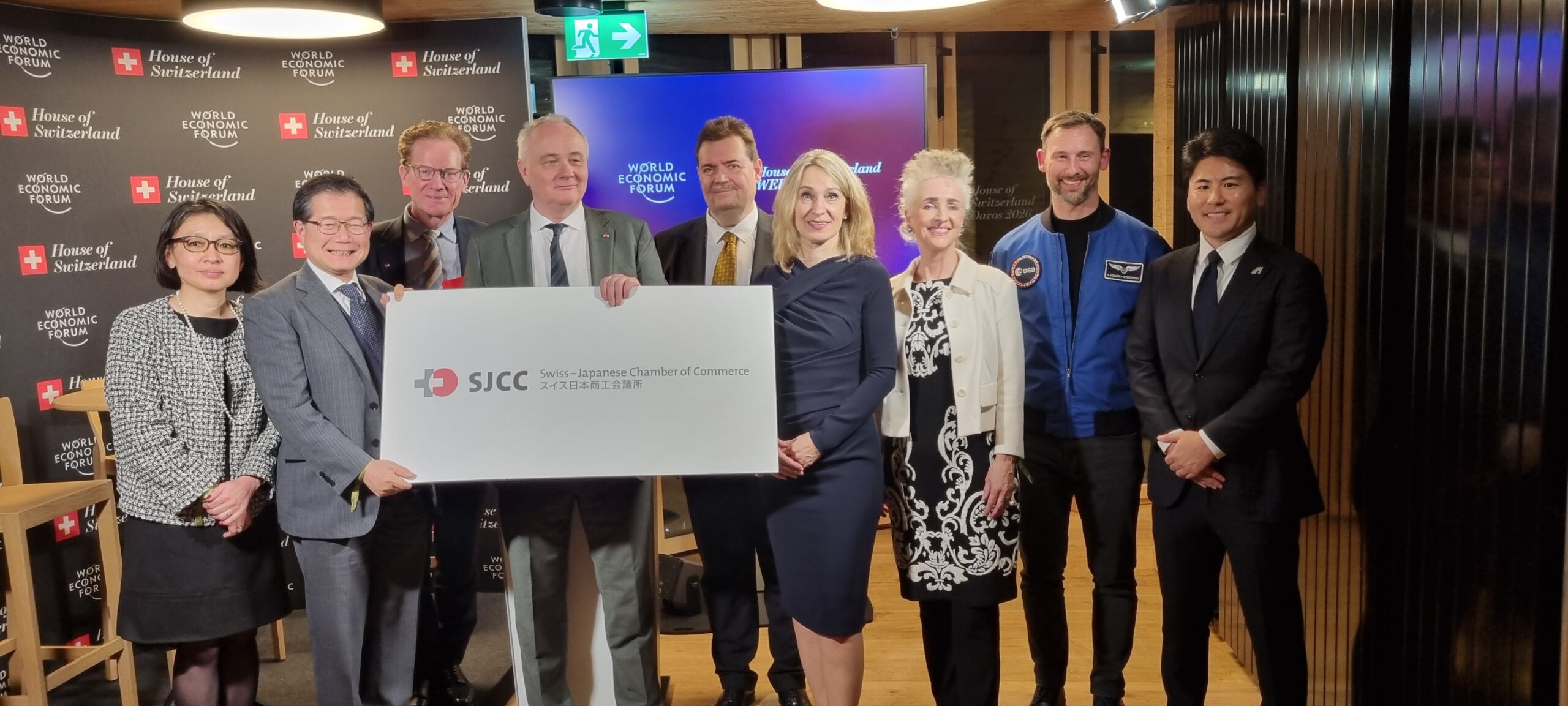
WEF 2026: CSA a new relevant player in the global New Space Economy
January 28, 2026
One year after its founding at the end of 2024, the Center for Space and Aviation Switzerland and Liechtenstein (CSA) has successfully positioned itself as a visible and recognized player on the global New Space Economy map. The CSA's presence in various panels at the World Economic Forum Annual Meeting 2026 underscores the strategic correctness of the path it has taken: The transformation of space exploration into an economically relevant domain of production and innovation does not primarily require new technologies, but rather new structures, collaborations, and systemic approaches.
Technology is available – the system is crucial
The central message of the CSA's contributions at the WEF was a two-part insight: despite enormous technological advances – for example, in reusable launch systems, commercial space stations, and falling launch costs – the full potential of the New Space Economy remains structurally limited. Long development times, fragmented stakeholder landscapes, institutional silos, and a lack of operational interfaces are slowing down implementation. The success of the next phase of development of the New Space Economy therefore depends crucially on the ability to overcome these barriers systemically.
This is exactly where the CSA comes in.
Space as an industrial production site
In several panels and roundtables, including contributions from Prof. Oliver Ullrich, Chairman of CSA and Director of the UZH Space Hub, and Prof. Elisabeth Stark, member of the CSA Board of Trustees and Vice President of Research at the University of Zurich (UZH) , a central paradigm of the New Space Economy became clear: low Earth orbit is evolving from a research space to an industrial production site. Says Oliver Ullrich: “Microgravity enables manufacturing and development processes that are physically impossible on Earth – with direct relevance for life sciences, biotechnology, medicine, semiconductors, new materials, and quantum technologies.”
The CSA is deliberately positioning itself at this interface between research, industrial application, and orbital infrastructure.
Access to the New Space Economy for Central Europe
As a binational center, the CSA creates structured access for Switzerland and Liechtenstein and Central Europe to the global New Space Economy. It brings together cutting-edge academic research, industrial players, and the operators of the next generation of commercial space stations – in an operational, coordinated, and scalable manner. This ensures that research results do not remain in the laboratory, but can be transferred into industrial value creation.
Starlab partnership and post-ISS continuity
Key milestones included strategic partnerships with Space Florida, the aerospace finance, development, and spaceport authority for the State of Florida, and Starlab Space LLC, a major successor to the International Space Station. Starlab is a consortium by Voyager Technologies, Airbus, MDA, Palantir and Mitsubishi Corporation.
At the end of 2024, the CSA and Starlab signed a memorandum of understanding for the operation of a Science Ground Module at Switzerland Innovation Park Zurich. The globally coordinated space and Earth station systems surpasses previous terrestrial cooperation frameworks. It represents a new architecture of global knowledge creation and is a key element for the long-term integration of Europe into the post-ISS era.
Strong national roots
The CSA's activities are closely embedded in the location and innovation strategy of the Canton of Zurich. In addition to the Innovation Park, there are central links to the Economic Affairs Directorate of the Canton of Zurich and the Dübendorf Air Base. This combination of research, business, and infrastructure creates the conditions for sustainable value creation.
Science, education, and capital
According to Elisabeth Stark, universities play in the CSA model an active role as a hub between basic research, education, and industrial implementation. At the same time, numerous discussions with international investors at the WEF confirmed a clear signal: The New Space Economy is increasingly seen as the strategic infrastructure for the next stage of industrial development. Capital is available, what is needed are resilient structures, credible partners, and viable ecosystems.
Outlook
The New Space Economy now has everything it needs to succeed. With its early, clear positioning, the CSA is ensuring that Switzerland and Liechtenstein not only keep pace but are also actively involved in shaping this development – scientifically, economically, and internationally.
Download
Media